
For example, where a project with higher return has a longer payback period thus higher risk and an alternate project having low risk but also lower return. In such cases the decision mostly rests on management’s judgment and their risk appetite. This has been a guide to the discounted payback period and its meaning.
Logistics Calculators
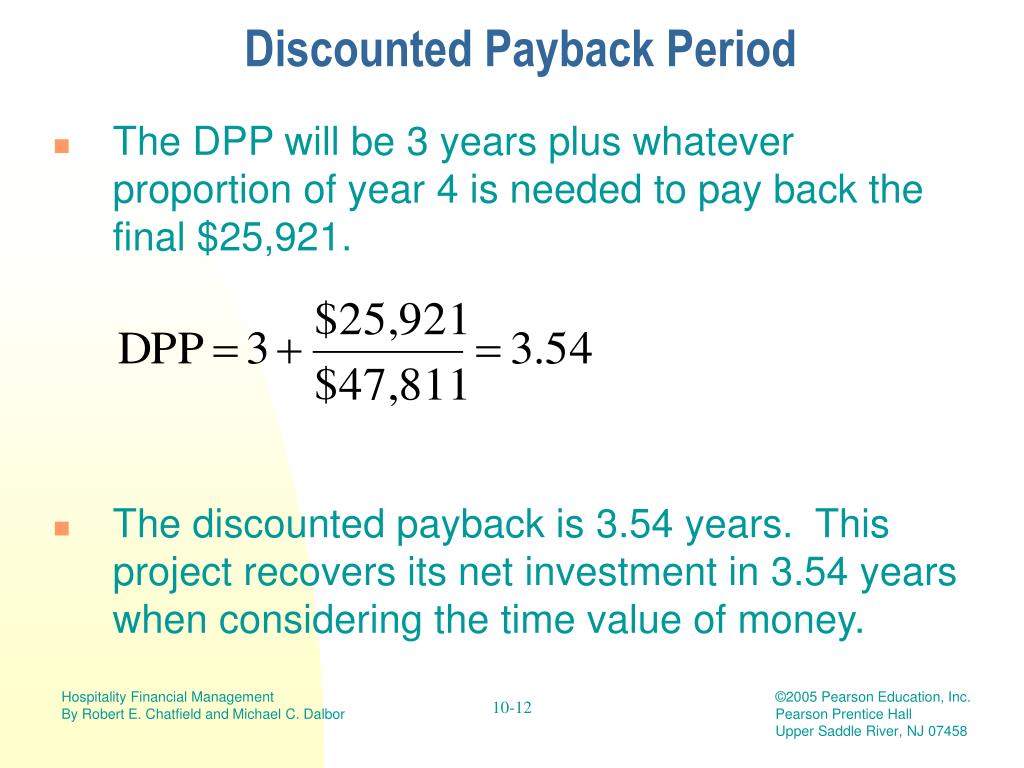
The standard payback period calculation is intended to be quite simple, and can be derived with minimal calculations. This is not the case when discounting is introduced to the formulation. Compared to the standard payback period calculation, discounted payback period is more complex and first requires a discount rate to be established.
Simple Payback Period vs. Discounted Method
You should also consider factors such as money’s time value and the overall risk of the investment. Despite these limitations, discounted payback period methods can help with decision-making. It’s a simple way to compare different investment options and to see if an investment is worth pursuing.
How Is the Discounted Payback Period Calculated?
Here we learn how to calculate a discounted period using its formula along with practical examples. Here we also provide you with a discounted payback period calculator with a downloadable excel template. The big difference between the regular payback period and the discounted payback period is that the latter considers the time value of money. The formula for the simple payback period and discounted variation are virtually identical. Others like to use it as an additional point of reference in a capital budgeting decision framework.
Discounted Payback Period Formula
- The discounted payback period (DPP) is a success measure of investments and projects.
- This makes it a good choice for decision-makers who don’t have a lot of experience with financial analysis.
- In this case, we are given the profit figure so need to adjust for depreciation of ($40,000/8 years) $5,000 per year, to give an annual cash flow of ($12,500 + $5,000) $17,500.
- It is hoped that this article will help candidates with both of these elements.
If undertaken, the initial investment in the project will cost the company approximately $20 million. The formula for computing the discounted payback period is as follows. Assume Company A invests $1 million in a project that is expected to save the company $250,000 each year. If we divide $1 million by $250,000, we arrive at a payback period of four years for this investment.
Payback Period: Definition, Formula, and Calculation
The discounted payback period adds discounting to the basic payback period calculation, thereby greatly increasing the accuracy of its results. It is significantly more accurate than the basic payback period formula, which can be seriously inaccurate when the cash flow period is quite long or the discount rate is high. Most capital budgeting formulas, such as net what are corporate budgeting exercises present value (NPV), internal rate of return (IRR), and discounted cash flow, consider the TVM. So if you pay an investor tomorrow, it must include an opportunity cost. The calculationtherefore requires the discounting of the cash flows using an interest ordiscount rate. Payback period refers to how many years it will take to pay back the initial investment.
The two calculated values – the Year number and the fractional amount – can be added together to arrive at the estimated payback period. In most cases, this is a pretty good payback period as experts say it can take as much as 7 to 10 years for residential homeowners in the United States to break even on their investment. Discounted payback period serves as a way to tell whether an investment is worth undertaking. The lower the payback period, the more quickly an investment will pay for itself. The calculation method is illustrated through the example given below. Suppose a company is considering whether to approve or reject a proposed project.
The payback period value is a popular metric because it’s easy to calculate and understand. However, it doesn’t take into account money’s time value, which is the idea that a dollar today is worth more than a dollar in the future. In this case, we are given the profit figure so need to adjust for depreciation of ($40,000/8 years) $5,000 per year, to give an annual cash flow of ($12,500 + $5,000) $17,500. DefinitionPayback is defined as the length of time it takes the net cash revenue / cash cost savings of a project to payback the initial investment. Like NPV, IRR doesn’t focus on the timing of cash flows, so it’s best assessed alongside the discounted payback period for a fuller picture. IRR tells you the discount rate at which the NPV of a project or investment is zero.